LATINOAMERICANOS ONLINE radio, tv, periódico y talleres para interconectar a los habitantes , migrantes, estudiantes y turistas latinoamericanos.
LATIN AMERICANS ONLINE LAONLINE audiovisual communication and online workshops, in Spanish, English, Portuguese, French and Quichua, to inform and connect Latin American inhabitants, migrants, students and tourists.
Liberia, one of the poorest and most conflictive countries in the world, was the first model of a manipulable state of the White House and the United States Department of State.
His goal was to return blacks dissatisfied with slavery to Africa in 1828.
At this time, the United States is trying to convert Mexico, Ecuador, Guatemala, and Paraguay into countries to retain and send those rejected by the United States, operating as neo-Liberias in Latin America, not in Africa.
The LATIN AMERICAN NEO-LIBERIAS, after the failure to do it with Cuba, Nicaragua, Venezuela, Colombia, Chile and Peru and Brazil and their success with Puerto Rico and Costa Rica are Mexico, Guatemala, and Ecuador.
It is about avoiding the existence of countries that are the focus of migratory hordes, which are currently led by Mexico in North America, Guatemala in Central America, and Ecuador in South America, which have also become battlefields in the War on Drug Trafficking.
The mechanism is to turn the countries mentioned into new Liberia, where North American democracy, which is based on the division of powers between the executive, legislative and judicial powers, presidential succession, through elections, and these elections must be controlled, promoted, and handled by the media, which is the power that in the United States puts and removes presidents, representatives, senators, and governors thanks to extraordinary inventions such as newspapers self-financed by national advertising, the radio, cinema, television and the internet that are American inventions.
In turn, the North American model of government has been more successful than the communist model of the USSR, which disappeared in 1992, and with this failure, NATO and the European Union grew, starting from the countries of Europe. from the East, oppressed by governments imposed in perpetuity from Moscow, through the so-called Socialist International, which created the USSR and the Vasovia Pact, and satellite countries like Cuba in the Caribbean, which was the opposite of National Socialism, which created Nazi Germany, in terms of racism as the ideological foundation of the party.
North American capitalism managed to overcome the Soviet communism of Lenin and Stalin, thanks to the fact that it allowed each human being to be the owner of what he created, the place where he worked, and the profits he could obtain so that anyone could be rich, but at the same time be an exploiter of other human beings and of nature without any respect for others, which gave rise to the so-called savage capitalism and transnational capitalism, to the extent that the industry found in North American capitalism the place, the moment and the most favorable winds.
On the contrary, communism cracked and collapsed because it tried to prevent people from being rich, from inventing their own work, their tools, their products, their innovations and creations, creating fashions, creating needs, markets, products, ideas, so that tried to turn human beings into a bunch of submissive, obedient and non-deliberative people, managed by a group that owned everything, what existed and the soul and mind of those who existed in that country, which should be led by the so-called Committee Central of the Communist Party.
In the European socialism that emerged in the Nordic countries, a form of government has been created in which it is possible to be rich, but it is not possible to be an exploiter of people, of natural resources, in a similar way to what happens in the USA, since equality is sought based on the same opportunities for all, which starts from developing qualities and virtues, individuality, one's own ideas, and different thoughts since they start from the idea that diversity is richness, not dispersion, but unfortunately, their racism, their blind belief in the superiority of the white race has blinded them, it is their narcotic, their dogma their fundamental creed.
In Latin America, the most violent region in the world right now, and where inequality has its reign, where evil has acquired extraordinary nuances, where lies have become political, a form of government, news, information, and even education, now a new model of government is emerging, where human beings can move throughout the American Continent, in a fluid manner, for which migratory waves, like drug trafficking, fracture borders, move money, drugs, products commercial, and even human labor, legally or illegally, making laws less important than life and life on this continent even more important than machines and infrastructure or profits or business.
In this new model of socialism, what is wanted is to invent mechanisms so that human beings are more supportive of each other, and that this solidarity does not become a platform for the opportunists, the richest, and the most violent to be the owners of a country.
Unfortunately, Latin America is experiencing a new religion where the dollar is God, where money is worth more than one's own life or the life of others, like what happens with hitmen, drug traffickers, soldiers, policemen, and those who protest or beg. on the streets.
Latin America is experiencing what the Roman soldiers, the Christians, the Ottomans, the Mongols, the conquerors or the settlers of Europe experienced centuries ago when they preferred to die rather than endure what was happening in their places of origin.
But this humanitarian catastrophe that Latin America is experiencing, and especially countries like Ecuador, happens when the world tries to overcome the aftermath of the Covid 19 pandemic, which has hit it brutally, more than because of the number of deaths due to the economic impact. in countries that moved on the razor's edge of the cruel human economy, which poses unlimited growth, in a world with limited resources on this planet.
America has suffered from its civil wars more than any other type of war throughout its history. We call civil wars when the army of a country uses its weapons and soldiers against the population and this reacts by using force, or weapons against its soldiers. This is different than conventional warfare, in which the armies of two or more countries or kingdoms face each other.
The first civil war was suffered by the Latin American countries that had been experiencing disputes over the presidencies and governments since their independence, which began at the beginning of the 19th century.
In Ecuador, the first civil war was called the War of the Chiguallos and it was a popular uprising repressed by the army, during the government of the first president of Ecuador, Juan José Flores, and this was similar to the rest of the Latin American countries. But in the United States, it had a colossal dimension. His Civil War killed more than 700,000 inhabitants, of a country that at that time did not even have 7 million, that is, more than 10% of the population. It was mainly due to the fact that repetition weapons were invented in that country, the machine gun, battleships, submarines, or military balloons, it was a revolution in the industrial production of weapons.
In Latin America, civil wars produced fearsome dictators such as the Duvaliers in Haiti, Trujillo in the Dominican Republic, Somoza in Nicaragua, Castro in Cuba, Ortega in Nicaragua, numerous dictatorships in the rest, such as those of Pinochet in Chile, the military in Argentina, Uruguay, Brazil, Stroessner in Paraguay, many in Bolivia, and in Peru, such as that of Fujimori, which was an electoral dictatorship of the right, in which the dictator won elections, and this president used the army against his people, with the excuse of the War against the Shining Path, or the electoral dictatorship of Maduro against the USA.
In Colombia, on the other hand, there was the longest civil war in the history of the Continent, possibly the World, between conservatives and liberals, which was very well used by the United States to make Panama independent, and then take that country to build the Panama Canal, which is the main infrastructure built by this country outside its territory. But this war of the Thousand Days later became the anti-communist war, which the United States started in the 1960s with the Bay of Pigs invasion in Cuba, and spread as civil wars throughout Latin America, in which the armies of our countries did not shoot at soldiers of other countries, but at their population.
The Anti-subversive or anti-communist War became a war on drug trafficking when the USSR fell, the Colombian guerrillas stopped being financed and armed by this country or Cuba and sought forms of self-financing, which was possible thanks to drug trafficking, kidnapping, and extortion or vaccinations of peasant people and towns, the first place where they recruited guerrillas, who later, like the cartels recruiting hitmen, did so among the gamines, or poor boys from the cities, who gave rise to the North American mafia and the drug cartels in Latin America.
Since the origin of Latin American countries, civil wars were firstly over land, which forced agrarian reforms in many countries, but in Colombia it was impossible, then the separation of the Church, which was the largest landowner and educator in the country. State, which originated the so-called Liberal Revolutions.
Currently, the war is for political participation, since the USSR was also the main financier of unions and trainer of union or indigenous leaders, who could send their children to study for free in that country, in the countries of the Warsaw Pact, or in Cuba.
When the street protest became a political weapon thanks to women, workers, students, Gandi, Mandela, and Afro-Americans, who saw themselves outside the rights and benefits of the so-called development society, the one that qualifies countries by developed countries and developing or underdeveloped countries, based on the level of industrialization they reach, our armies have become the main actors in the civil war against demonstrators in Latin America, and they are becoming so again in the United States.
Today Colombia, Mexico, Peru, Guatemala, Honduras, El Salvador or Ecuador are experiencing a new civil war called the War on Drug Trafficking, against the cartels and the gangs.
This is a civil war that has been going on for 40 years, which is being won by drug traffickers, gangs and cartels, armies and police formed, trained, equipped, and even directed by the State Department, the DEA, the CIA, or the Department of Justice of the United States, through puppet presidents, who win elections in costly and tricky electoral campaigns and which is also a big arms business, for both sides, the armies and the drug traffickers.
When the human being believed that the most valuable that exists on the planet was gold, the kings, emperors, and gods manifested their power with gold, until when the gold standard became the one that allows governments to issue currencies, in which they must be backed Until now, but now the dollar is backed by other currencies, or by the estimated value of its assets, industry, or products.
In all these millennia we always believed that gold was the most valuable. For gold, the Spanish conquerors lost their heads, their own self-esteem and were able to make the impossible possible, such as discovering a new continent, conquering huge indigenous empires, with only a few men, or entering inaccessible mountains like the Andes, in dangerous jungles, like the Amazon, or crossing the world's largest ocean, the Pacific.
But after that insane time, it was believed that the land was the most valuable thing that exists, the settlers left their countries to go to other continents, they fought with the natives of those continents until they snatched their land.
It was thought that it was possible to build and even bring heaven and God to earth in huge haciendas, where there were black slaves, or indigenous serfs, who did and pleased the big landowners at all whims.
But after that period came the period in which machines, from automobiles, ships, planes, to factories and now computers or robots, were thought to give us happiness and, above all, freedom to human beings.
Despite the fact that this is true, the same machines have been in charge of limiting us, of manipulating us, of finally making us work for them and not as we had thought, that they would work for us.
Today the car has more importance more attention and even costs, than the children themselves, love is made with wheels, gasoline perfume, and the vanity is lined with painted cans until pollution and climate change have put the machines among those to blame for the ecological disaster we are experiencing.
So drugs that alter the brain and human behavior have become the most valuable thing in the world, first because they are illegal, second because they are expensive, third because they can free the human brain from those ties created by cultures, education, religions, laws, fashions, the media and can alter the established order, inside and outside each individual, turning him into a genius, or stupid at the same time, of course for a short time, increasingly shorter in time. To the extent that the body creates resistance to drugs and demands more of them, then at the same time, the body creates weaknesses that make it susceptible to self-inflicted death or suicide, or to the new pandemic created by globalized human society, or by the covid, called depression, or social isolation.
Drugs, which have always been a social mediator and lubricant, today have enormous value and great demand, so much so that they have turned the Taliban, a narco-guerrilla, from one of the poorest countries in the world, into incredible winners, of the greatest world power ever created in history, after 20 years of war.
Today, the poor of Latin America, the most unequal and unjust continent in the world, are uncontrollable invaders of North America and Europe, where those who one day governed them came from, exploited, gave them a common language, religion, and race, the mestizo, and thanks to drug trafficking.
The most audacious, intrepid, daring, and determined beings on the planet are no longer the Spanish and Portuguese conquerors, nor the English, French and Dutch pirates, nor the Romans, the Vikings, or the Mongols, nor the white settlers, as they were for centuries, now are Hispanics, Latin Americans, and black Africans
Again the most direct descendants of homo-sapiens, who appeared in Africa 250,000 years ago, are facing the last descendants of Neanderthal man, the origin of the white race, who has lost his fertile capacity, and his immunological capacity in this industrial age after they were conquerors of the world.
Like the conquerors and pirates, who were capable of anything for gold, or the European settlers who lost their scruples over land, or the English and North American merchants and businessmen, who had no respect for Chinese culture, and converted to the largest and richest empire in pre-industrial history in opium addicts, to humans in Coca Cola addicts, to North American soap operas, inventions, and conveniences, such as TV and the Internet, today the poor of the planet headed by Latin Americans and Africans invade the countries that conquered, colonized and subjugated them through drugs, which is why the rich pay more and demand more, as before they did to the poor with alcohol.
On October 9, 1820, Guayaquíl, the most important port and naval shipyard of Spain in the Pacific of South America, which today celebrates 201 years of independence, became an English port, then North American and finally international. Since then, it has experienced deterioration, as it has become one of the cities with the largest population in slums, in proportion to those who do not live in those neighborhoods in Latin America.
Today it is the most violent city in Ecuador, that violence is experienced in the Port, in the streets and even in the prisons, where 118 prisoners killed each other, in the most brutal way imaginable, in a single day.
Ceasing to be part of Spain, it turned us into a country in the backyard of the United States.
Unlike the former USSR, which supported the poor, workers, and students to organize themselves and become government, the United States has supported the elites, who are descendants of rich Spaniards, pirates, merchants, bankers, landowners, who For 500 years they have turned Ecuador into a valley of tears.
This support has been through academic training and studies that have been trained by ministers, presidents, businessmen who support this capitalist model, of the military, who made our military the worst economic weight in the country, for which they are called eat them for pleasure, because unlike the rest of Ecuadorians, that what they eat becomes work, in the military it becomes parasitism, they have become the worst executioners of our own people, we have to fatten them in peacetime, defend them in time of war, and fear them in time of conflict.
The Ecuadorian military is a state within a state, they obey the Pentagon without question, and they have lost all the wars in which they have participated, where we Ecuadorians have had to defend them as recruits, reservists or cannon fodder. Even in the last war with Peru, in 1995, when we won on the battlefield, we lost it in the signing of a treaty, which finally ratified the Rio de Janeiro Treaty of 1941, in which the United States, which supported the invasion Peruvian of our territory that in 1936 Delano Roosevelt, gave to Peru.
But the Ecuadorian military, unlike the Chileans, Colombians, Peruvians, Argentines, Uruguayans, Paraguayans, Bolivians, Brazilians, or Central Americans, have not been mass murderers in recent times.
Ecuador, in addition to handing over the ports to the British, as payment for the foreign debt since 1830, gave them to the USA, after the construction of the Panama Canal, these ports became North American ports in the Pacific, and from there we export bananas since 1948, then oil since 1974, shrimp since 1985, fish since 1995, which for the most part ends up in the United States, which pays us for these products very badly, and which has made us eternal debtors, as we were in those times. of the Colony, with the difference that in those times, Ecuadorians were debtors of the bosses, landowners, usurers and later of the bankers, now we are it in addition to the IMF, and the North American banks.
But what is better? It is the question of every day, to be a North American colony, which is a country that daily invents, creates, investigates, explores, changes the world with its inventions, revolutionizes everything, or to be from Russia, the inheriting country of the USSR, that he became a savage capitalist, after his defeat in the Cold War.
Although there are countries that have done badly as colonies of the United States, such as Ecuador, others have done better, such as Costa Rica, Puerto Rico, Chile, Uruguay, and the Dominican Republic.
This has also happened with the British colonies, in which Canada, Australia, New Zealand, which are still subject countries of the Queen of England, are the countries at the forefront of development, which makes us see that the independence of the crowns Europeans, it has not been for the better, in all cases, since the British colonies in Africa. they have lived through the disaster, with the exception of South Africa.
We are left with the question of whether we had not done better as part of Spain, than as colonies of the United States, since countries such as Colombia, Ecuador, Peru, Bolivia, Honduras, Guatemala, El Salvador, Paraguay, Argentina, even Mexico or Brazil, They have not done well as allies of the USA, but indisputably, the countries that have opposed the United States in America, such as Cuba, Nicaragua, or Venezuela, have fared worse than when facing the United States, they have experienced overwhelming crises and terrible. Today those countries are the example, so that the rest of us do not have the courage to oppose the whims of US presidents, the Pentagon, the DEA, National Security or the US Congress.
Ecuador at this time is governed by Guillermo Lasso, presidents imposed through an election in which Rafael Correa was eliminated first, to win them, then Yaku Pérez, the indigenous man who demanded a vote count to verify an electoral fraud in favor of the current one. President Guillermo Lasso.
Elections in Latin America are won by those who have the support of the owners of the radio, newspapers or TV, who are North American inventions that drive participation and popular will. they create false idols, perfect candidates, and finally tell us who, how, when, and where to vote.
The problem of the countries that oppose the United States in Latin America is that they do not have the real capacity to resist an economic blockade, sustain a media war, an asymmetric war, or avoid a supply crisis, which ends up producing popular discontent, emigration. , which is the hemorrhage of our countries, and this humiliates us in internal violence, which weakens us and expels us from our own countries, along with debts, and the malfunction of justice, education, health, credit, the police, the army, epidemics or disasters, which consume and suffocate us,
But the policy of the United States with Latin America has turned our countries into factories for the poor, but now they already manage cell phones, know us, relationships on both sides of the southern border of the USA, and of people who have the ability to illegally cross any border or to produce and commercialize the worst enemy of the United States, which is drugs, which one day helped it conquer the world, such as tobacco or painkillers, but are now killing its people.
Cómo Estados Unidos luchó para convertirse en un imperio (y luego trató de ocultarlo)
Daniel Immerwahr*
Para History Extra
FUENTE DE LA IMAGEN,GETTY IMAGES
Pie de foto,
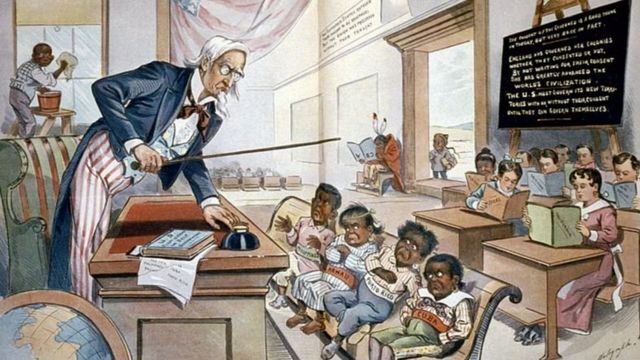
Caricatura de 1899 sobre la política estadounidense de enseñar inglés a sus nuevas colonias con niños de Filipinas, Hawái, Puerto Rico y Cuba en la primera fila.
El 25 de octubre de 2018, una tormenta de categoría 5 azotó a Estados Unidos.
Con vientos máximos sostenidos de 241,4 kilómetros por hora, fue la tormenta más poderosa en cualquier lugar de la tierra ese año, y la más poderosa en la historia de EE.UU. desde 1935.
Rompió los techos de las casas y dañó gravemente la red eléctrica.
A pesar del daño, la supertormenta apenas fue noticia. Recibió menos del 1% de la cobertura televisiva que se le dedicó al huracán Florence, una tormenta que había azotado a Carolina del Norte a principios de ese año.
Fue, según escribió Anita Hofschneider, de la Columbia Journalism Review, "el supertifón que los medios estadounidenses olvidaron".
Esa tormenta atrajo poca atención debido al lugar donde golpeó. El tifón Yutu arrasó Saipan y Tinian en las Islas Marianas del Norte, al oeste del océano Pacífico.
Estas islas son parte de EE.UU., y las personas nacidas allí son ciudadanos estadounidenses. Pero pocos en el país parecen saberlo.
"Me temo que la mayoría de los estadounidenses no saben que tenemos territorio de ultramar", comenta Phil Klotzbach, un experto en huracanes de la Universidad Estatal de Colorado.
FUENTE DE LA IMAGEN,GETTY IMAGES
Pie de foto,
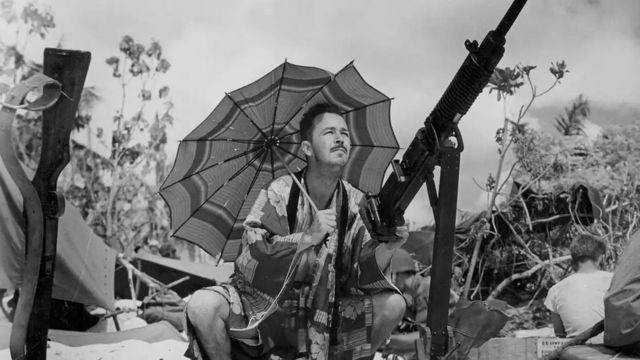
Un guardacostas estadounidense vistiendo un kimono durante la Segunda Guerra Mundial.
El clima, como la guerra, tiene una forma de enseñar lecciones de geografía. De hecho, EE.UU. tiene varios de territorios de ultramar, incluyendo Puerto Rico, Guam y Samoa estadounidense. Y ha tenido más en el pasado.
En vísperas de su entrada en la Segunda Guerra Mundial, el imperio estadounidense (el cual incluía Filipinas así como los territorios de Hawái y Alaska, casi dos décadas antes de que estos dos últimos se convirtiesen en estados en 1959) contaba con unos 19 millones de colonos.
En ese entonces, si vivías en EE.UU. (el país completo, no solo en la parte continental de Norteamérica), era más probable que fueses un colono que inmigrante.
De hecho, había más colonos que afroamericanos.
Los historiadores de hoy están lidiando con estos hechos. Cada vez con más frecuencia cuentan la historia de EE.UU. como la de un imperio.
La expansión de un imperio
Esa historia comienza desde el primer día de la nación. "El nombre de esta Confederación será Estados Unidos de América", según el borrador de Artículos de la Confederación de 1776 preparado por John Dickinson, capturando la embriagadora ola de posibilidades políticas de esos primeros días.
El país sería una unión más que un imperio, compuesto por estados más que una patria y colonias.
Excepto que el nombre no era exacto. Cuando Reino Unido ratificó el Tratado de París en 1784, que otorgó soberanía al país, no era una unión de estados. El gobierno había tomado las tierras más occidentales de estados como Virginia y Massachusetts y las había puesto bajo supervisión federal.
Por lo tanto, EE.UU. era una colección de estados y territorios, y así ha sido desde entonces.
Durante las primeras siete décadas más o menos de la historia de EE.UU., esos territorios colindaban con los estados y se esperaba que se unieran a ellos.
Pero solo tres años después de completar su anexión occidental final en 1854 (obteniendo una porción de México conocida como la Compra de Gadsden), EE.UU. se embarcó en una nueva fase de expansión en el extranjero.
Empezó reclamando docenas de islas deshabitadas en el Caribe y el Pacífico, fuentes de guano, un fertilizante esencial para granjas resecas con nitrógeno.
Tras un trato con Rusia incorporó a Alaska. Una guerra fundamental con España en 1898 trajo a Filipinas, Puerto Rico y Guam al país. Y las tierras no españolas de Hawái y Samoa fueron anexadas aproximadamente al mismo tiempo.
Para 1900, los territorios de ultramar abarcaban un área tan grande como todo EE.UU en su fundación, y tenía una población de más del doble de la que vivía en el territorio original.
El uso de la palabra "América"
Impresionados por la expansión del país en el extranjero, los cartógrafos ofrecieron nuevos mapas mostrando a Filipinas, Puerto Rico y otros territorios junto a los estados.
Los escritores, convencidos de que el imperio de ultramar marcaba una nueva era, reconsideraron el nombre del país.
Técnicamente, su nombre era aquel que Dickinson le había dado ("Estados Unidos de América"), pero en el siglo XIX se le había llamado más comúnmente "Estados Unidos", "La Unión" o "La República" para abreviar.
Sin embargo, después de la gran fiebre por la tierra imperial, estos nombres ya no encajaban tan bien. Fuera lo que fuera el país, no era una unión, no era república y no se limitaba a los estados.
Se propusieron varios nombres: "América Imperial", la "Gran República" y, una frase que apareció en el título de siete libros publicados en la década posterior 1898, la "Gran América".
La insatisfacción con "Estados Unidos de América" llevó a un cambio verbal más duradero.
Antes de 1898, aunque su gente se llamase "estadounidense", era inusual llamar al país "Estados Unidos de América". Uno podía viajar más de 8.000 kilómetros y leer 100 periódicos antes de encontrar ese nombre, según observó un escritor británico.
"Estados Unidos de América" no apareció en ninguna de las canciones patrióticas (como "Yankee doodle", "The battle hymn of the republic", "Hail, Columbia", "The starts and stripes forever", "The star-spangled banner").
Una búsqueda de discursos de presidentes desde la fundación hasta 1898 arroja solo 11 referencias inequívocas al país como "Estados Unidos de América", aproximadamente una por década.
Sin embargo, después de 1898, las cosas cambiaron rápidamente.
Theodore Roosevelt, el primer presidente que asumió la presidencia después de la guerra contra España, usó la palabra "América", en su primer mensaje anual y luego con frecuencia a partir de entonces.
El nombre era más suelto, expansivo y no implicaba nada acerca de que el país era una unión de estados.
Cada presidente desde entonces ha usado la palabra "América" libremente. Y surgieron nuevos himnos con títulos como "America the beautiful" ("América la hermosa") y "God bless America" ("Dios bendiga América").
Un imperio oculto
En los años posteriores a 1898, era obvio que EE.UU. era un imperio. Sus mapas mostraban las colonias, y hombres poderosos en Washington vociferaban abiertamente sus ambiciones imperiales.
Pero entonces ocurrió algo extraño. Quizás debido al agotamiento de la violencia en Filipinas, o debido a la persistente visión del país como república, los poderosos comenzaron a ignorar a las colonias.
Sin renunciar a ellas, EE.UU. simplemente habló menos de ellas, como ocultándolas bajo la alfombra.
En la década de 1910, las colonias habían desaparecido en gran medida de los mapas y ya no se les llamaba como tal. Esa palabra, advirtió un funcionario federal en 1914, "no debe usarse para expresar la relación que existe entre nuestro gobierno y sus pueblos dependientes".
Esta disonancia cognitiva en torno al imperio, debería decirse, fue bastante inusual.
Reino Unido no estaba confundido sobre si tenía colonias o no. Las honraba anualmente el 24 de mayo, Día del Imperio, que se celebró en las escuelas durante décadas y se convirtió en feriado oficial en 1916.
Da la casualidad que EE.UU. tenía su propia festividad patriótica, una que también empezó en las escuelas antes de recibir el reconocimiento federal en 1916.
La versión estadounidense fue llamada "Flag Day" ("Día de la bandera"), y fue diseñada para alentar a los ciudadanos a reunirse "en una demostración unida de sus sentimientos como nación", como lo expresó el presidente Woodrow Wilson en 1916.
No hubo feriado para el imperio.
Los escritores dijeron poco acerca de las colonias. El compromiso literario más famoso con ellos fue probablemente Coming of age in Samoa ("La mayoría de edad en Samoa"), una muy leída etnografía de 1928 escrita por la antropóloga Margaret Mead.
Pero Mead escribió sobre Samoa la región, no Samoa estadounidense, la colonia donde ella había vivido. Y evitó por completo mencionar colonias, territorios e imperios.
Es completamente posible leer el libro de Mead sin darse cuenta de que el "pueblo polinesio moreno" que ella describe que se encuentra en una "isla del Mar del Sur" son, al igual que ella, ciudadanos estadounidenses.
FUENTE DE LA IMAGEN,GETTY IMAGES
Pie de foto,
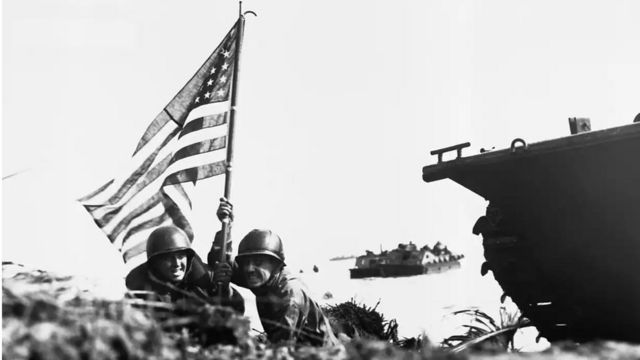
Soldados estadounidenses aterrizan en Guam el 21 de julio de 1944 al comienzo de la batalla para retomar la isla de de Japón.
En 1930, un año representativo, el New York Times publicó más artículos sobre Polonia que sobre Filipinas. Más sobre Albania que sobre Alaska.
Publicó casi tres veces más artículos sobre el territorio más grande de Reino Unido, India, que sobre todos los territorios de EE.UU. combinados; territorios que albergaban a más del 10% de la población de EE.UU.
Esta falta de atención a las colonias importaba. Importó especialmente en la década de 1930, cuando las ambiciones imperiales de Japón en Asia se hicieron claras.
Un vistazo rápido al mapa mostró a Guam, Filipinas, Alaska, Samoa estadounidense y Hawái como objetivos potenciales. De hecho, Japón finalmente los atacó a todos.
Pero las encuestas mostraron poco interés en la opinión pública en enviar al ejército estadounidense a defender esos lugares, y los estrategas militares hicieron poco para fortalecerlo.
Como resultado, las escasas defensas en los territorios del Pacífico demostraron ser incapaces de repeler el primer ataque de Japón cuando este finalmente llegó en diciembre de 1941.
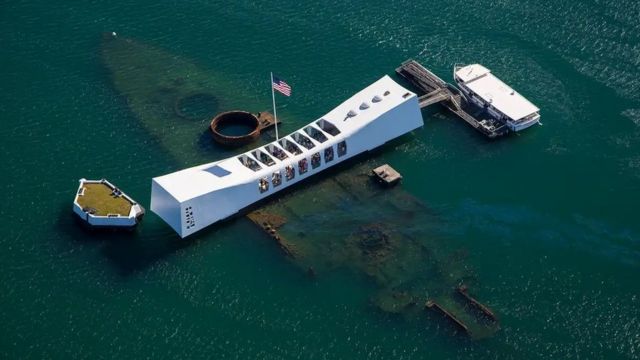
Ese ataque generalmente se recuerda en EE.UU. simplemente como un ataque a la base naval de Pearl Harbor en Hawái. Sin embargo, en un lapso de horas, Japón también atacó los territorios estadounidenses de Isla Wake, Guam y Filipinas, las colonias británicas de Malaya y Hong Kong; y el reino independiente de Tailandia.
Algunos ataques se lanzaron el 7 de diciembre y otros el 8 de diciembre, pero solo porque la maniobra de Japón cruzó la línea de cambio de fecha internacional.
El evento, conocido en EE.UU. como "Pearl Harbor", fue de hecho un ataque casi simultáneo en varias posesiones de los Aliados en el Pacífico.
FUENTE DE LA IMAGEN,GETTY IMAGES
Pie de foto,
El USS Arizona Memorial recuerda el ataque a Pearl Harbor el 7 de diciembre de 1941.
Pearl Harbor fue el primer objetivo estadounidense alcanzado. Pero claramente no fue el lugar donde los japoneses hicieron el mayor daño.
La historia oficial del Ejército de EE.UU. califica el ataque a Filipinas como igualmente dañino. Además, mientras que el ataque a Pearl Harbor fue solo eso, un ataque individual que nunca se repitió, la incursión en Filipinas fue seguida por más asaltos, luego por la invasión y la conquista.
Filipinas, Guam, la Isla Wake y el extremo occidental de Alaska, cuyas poblaciones ascendían a más de 16 millones de ciudadanos estadounidenses, recayeron en manos de los japoneses.
EE.UU. finalmente recuperó sus territorios perdidos del Pacífico, pero a un costo que rara vez se reconoce. Bombardeó todas las estructuras importantes de Agaña (ahora Hagåtña), capital de Guam, en su lucha por reconquistar la isla.
Manila, capital de Filipinas, fue igualmente diezmada, al igual que muchos otros centros urbanos filipinos.
"Arrasamos ciudades enteras con nuestras bombas y proyectiles", relató el alto comisionado filipino. Al final, dijo: "no quedó nada".
Se estima que más de 1,5 millones de personas en Filipinas murieron durante la Segunda Guerra Mundial. Fue fácilmente el evento más sangriento que haya tenido lugar en suelo estadounidense, más del doble de letal que la Guerra Civil.
La guerra en Filipinas no es parte de la memoria nacional en EE.UU. El National Mall en Washington D.C. no tiene un santuario para los muertos de esas islas. La carnicería fue, como el tifón Yutu, algo que sucedió "allí", de relevancia limitada en Nueva York, Chicago y Los Ángeles.
Sin embargo, vale la pena pensar en el imperio. Filipinas ya no es una colonia de EE.UU., habiendo obtenido su independencia en 1946, y Hawái y Alaska ahora son estados.
FUENTE DE LA IMAGEN,GETTY IMAGES
Pie de foto,
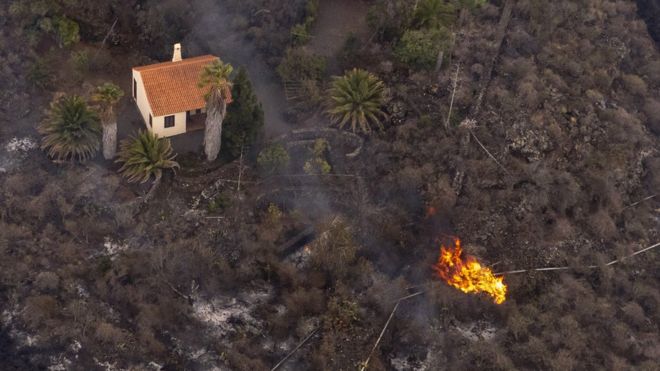
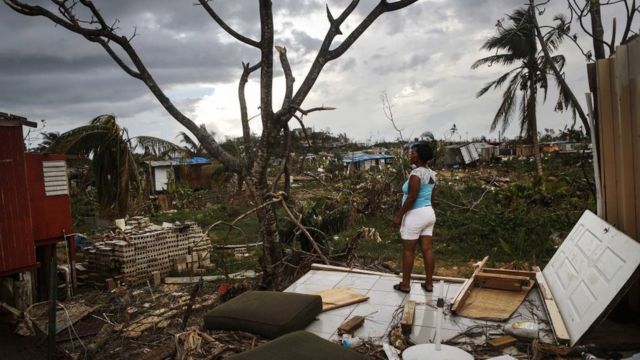
Destrozos ocasionados por el huracán María en Puerto Rico en 2017.
Pero EE.UU. todavía tiene cinco territorios de ultramar habitados: Puerto Rico, Samoa estadounidense, las Islas Vírgenes, Guam y las Islas Marianas del Norte.
Unos cuatro millones de personas viven en ellos, cuatro millones de personas que no pueden votar en las elecciones presidenciales, no están protegidas por la constitución y no tienen ningún papel en la elaboración de leyes federales.
Esta privación de derechos es importante. En 2017, el huracán María azotó a Puerto Rico y le cortó la electricidad durante meses. Miles murieron como resultado de la tormenta, pero no fue el clima en sí lo que los mató directamente. Fue una negligencia de larga data, seguida de una falta de ayuda federal después de que azotó el huracán.
"Reconozcan que los puertorriqueños somos ciudadanos estadounidenses", fue la súplica desesperada del gobernador de la isla, Ricardo Rosselló.
Sin embargo, una encuesta de los habitantes de EE.UU. realizada después del huracán mostró que solo una pequeña mayoría, y apenas un tercio de los adultos menores de 30 años, estaban al tanto de ese hecho.
Uno se pregunta si esos números serán más altos cuando llegue la próxima tormenta.
*Daniel Immerwahr es profesor asociado de Historia en la Universidad del Noroeste de Illinois. Su último libro es "How to Hide an Empire: A Short History of the Greater United States" (Bodley Head, 20